India’s horticulture supply chain suffers from post-harvest losses, poor cold chains and weak logistics. Learn why good intentions hurt farmers and what must change.
Horticulture Supply Chain Reforms in India: Are We Hurting Farmers with Good Intentions?
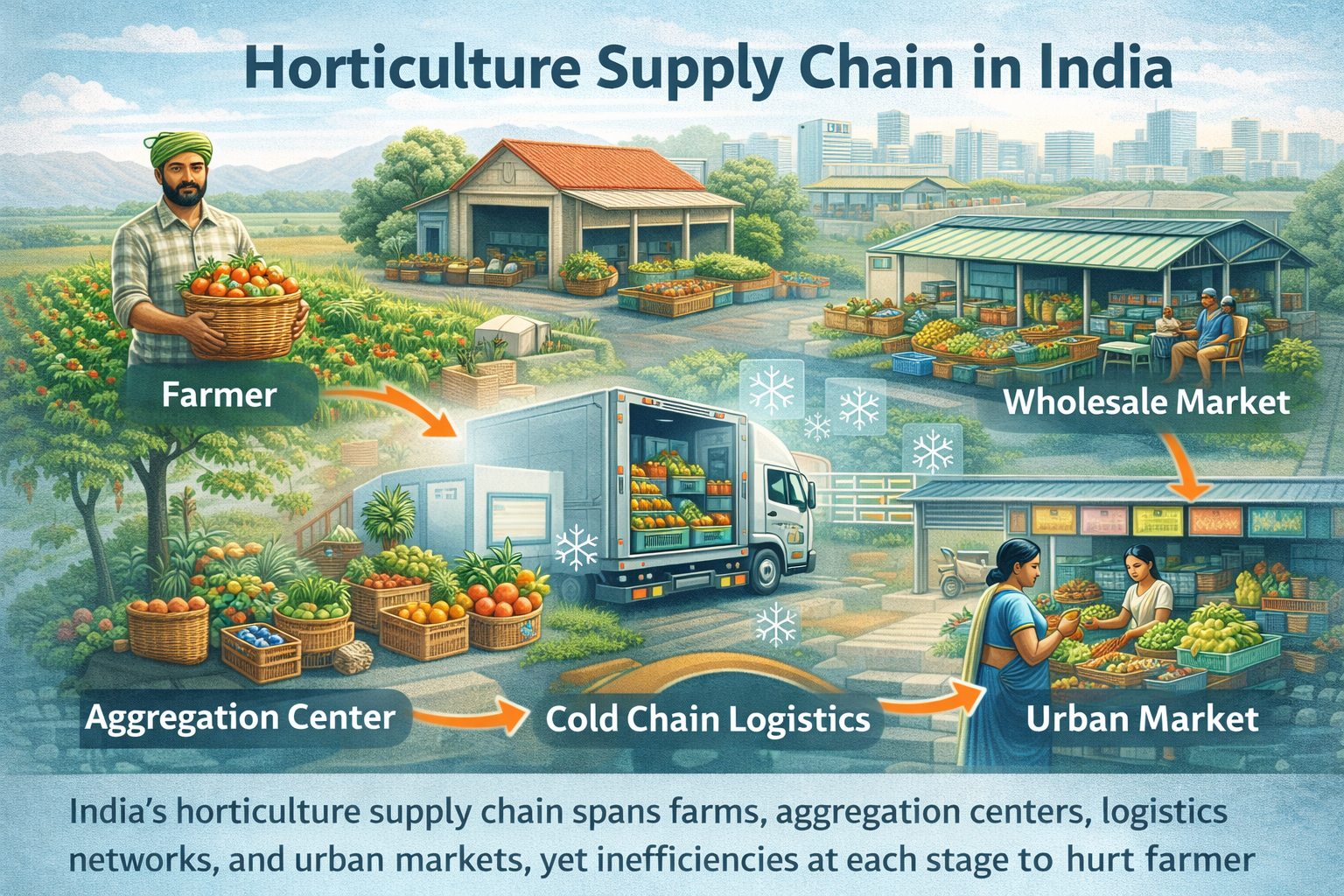
India’s horticulture sector produces more fruits and vegetables than ever before, yet farmer incomes remain volatile, post-harvest losses remain high, and supply chains remain inefficient. Despite numerous reforms, subsidies, and schemes, the outcomes often contradict the intentions.
This article examines how well-intended horticulture supply chain interventions are unintentionally harming farmers, and what structural corrections are urgently needed.
The Paradox of Growth Without Prosperity
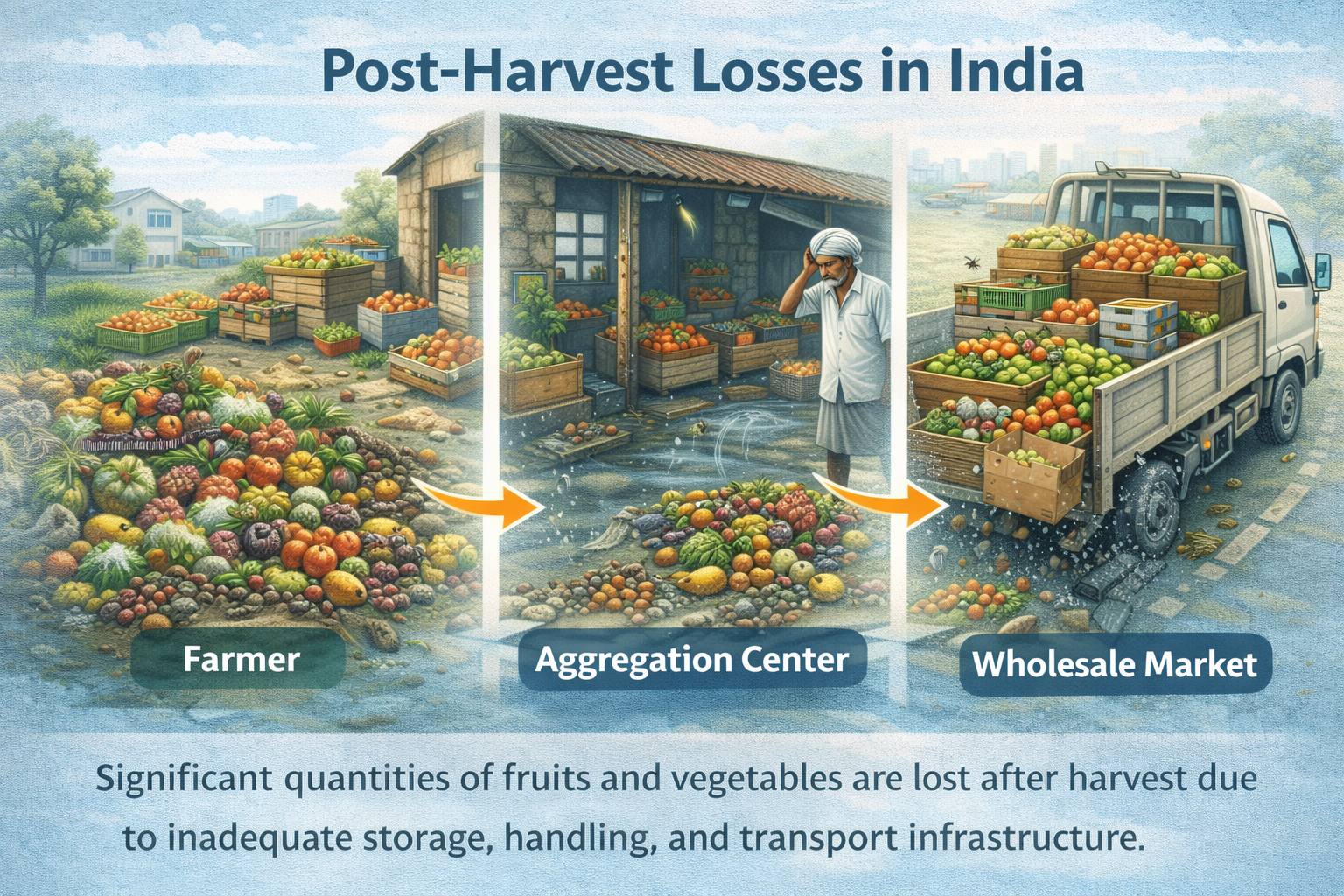
India is one of the world’s largest producers of fruits and vegetables, but 20–30% of horticultural produce is lost post-harvest due to poor handling, lack of cold chains, and fragmented logistics.
Production has increased, but:
- Market access has not
- Storage infrastructure has lagged
- Price discovery remains distorted
The result is oversupply at the farm gate and scarcity at the consumer end.
How “Farmer-Friendly” Policies Backfire
1. Production-First, Market-Last Thinking
Most schemes incentivise production, not market readiness. Farmers are encouraged to grow more without parallel investments in:
- Aggregation
- Cold storage
- Processing
- Demand forecasting
This leads to gluts and price crashes.
2. Fragmented Supply Chains
India’s horticulture supply chain is broken into:
- Smallholder farmers
- Multiple intermediaries
- Poorly regulated transport
- Inefficient mandis
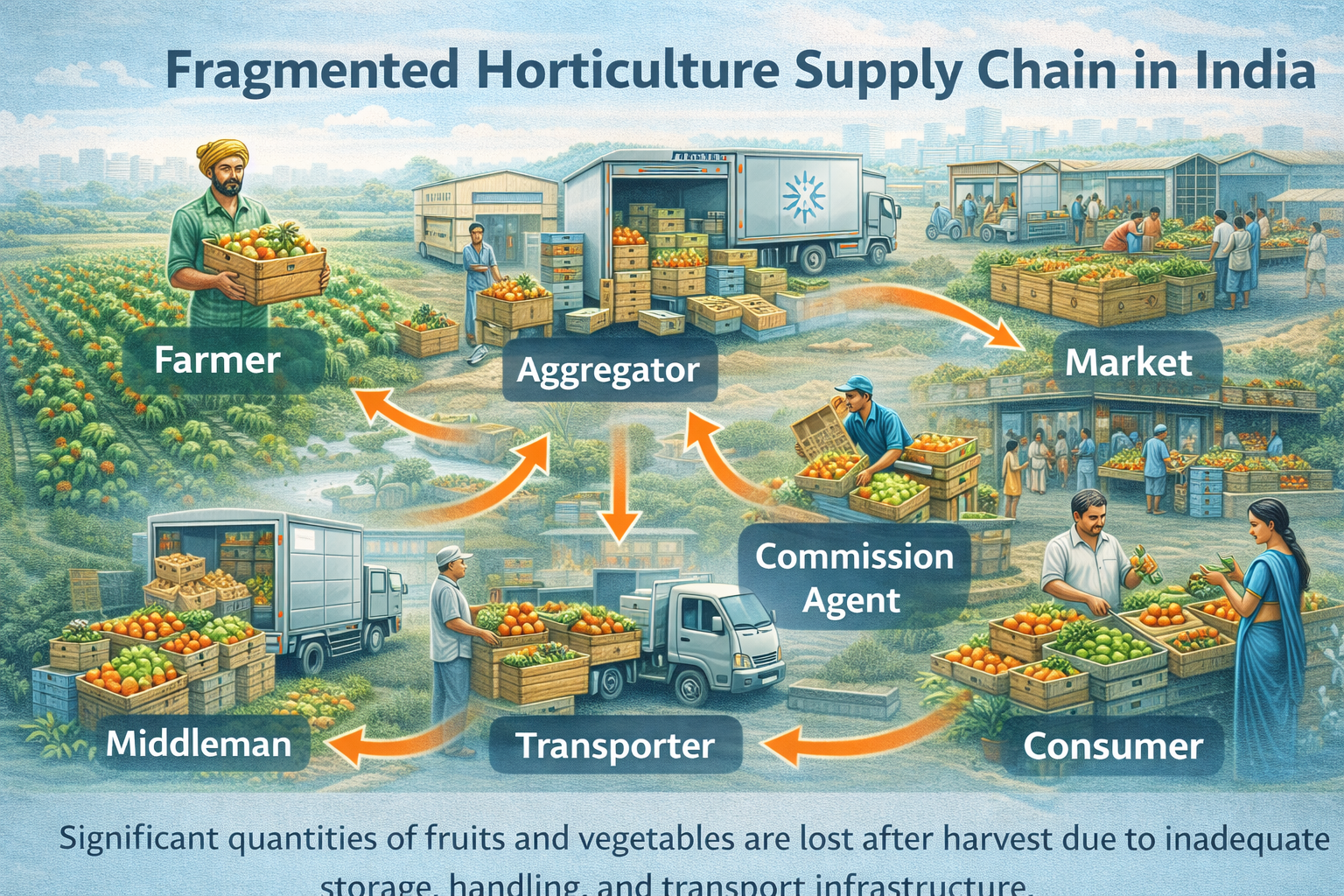
Each layer extracts value, while the farmer absorbs risk.
3. Cold Chain ≠ Cold Storage
Policy often equates cold chain with static cold storage, ignoring:
- Farm-level pre-cooling
- Reefer transport
- Packhouse operations
- Ripening and distribution controls
- ICAR horticulture research and post-harvest management
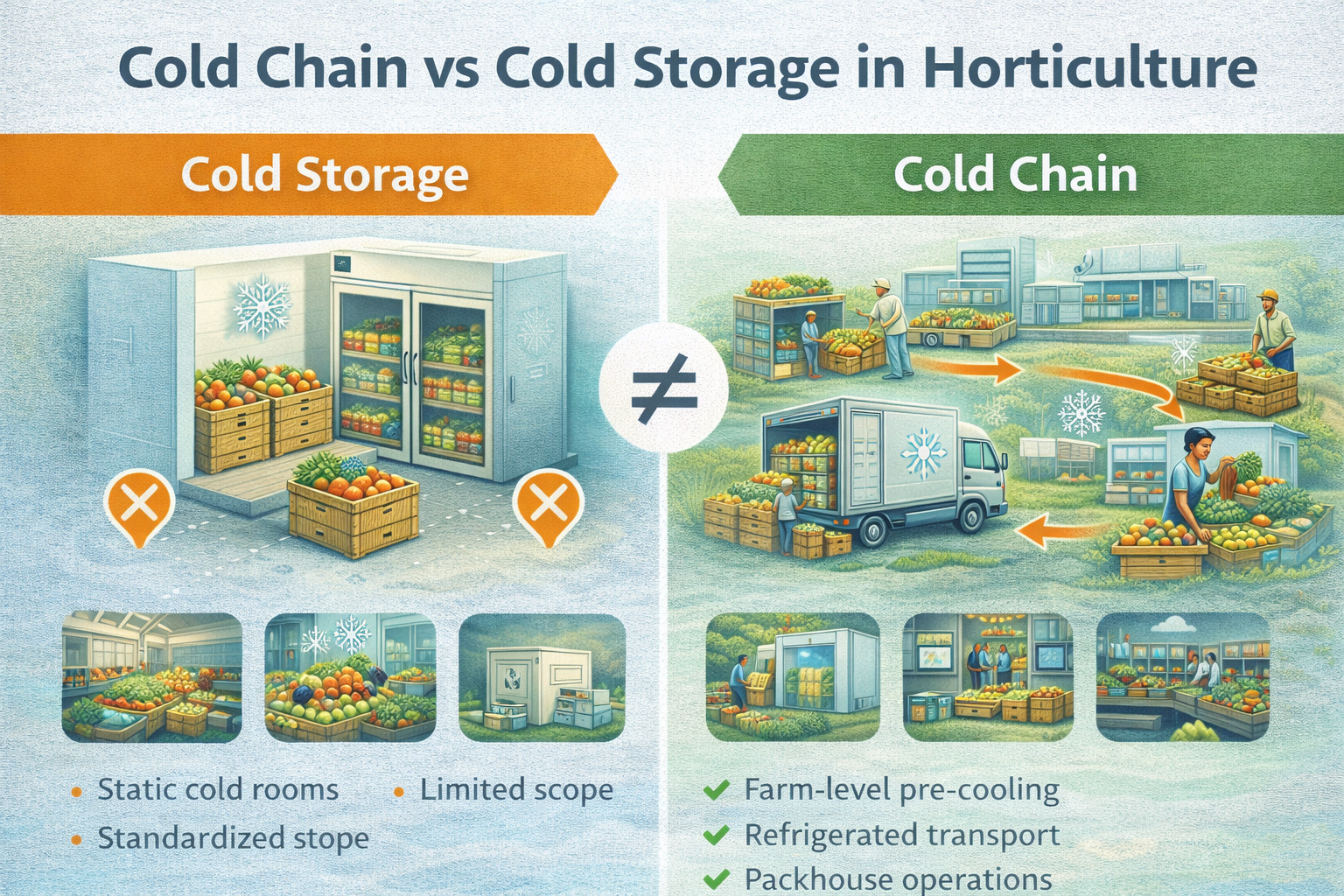
Without end-to-end cold chains, infrastructure becomes underutilised or misused.
The Hidden Cost of MSP-Like Thinking in Horticulture
Unlike cereals, horticulture is perishable and demand-sensitive. Applying MSP-style protection:
- Distorts planting decisions
- Encourages monocropping
- Increases waste
Horticulture needs market-linked price discovery, not blanket protection.
Logistics Is the Missing Link
Most reforms ignore logistics engineering:
- Route optimisation
- Time–temperature management
- Load consolidation
- Urban distribution planning
Without logistics efficiency, even high-value crops lose competitiveness.
Why Aggregation Matters More Than Subsidies
Farmer Producer Organisations (FPOs) work only when they:
- Aggregate volume
- Standardise quality
- Negotiate logistics
- Access institutional buyers
- Food processing and cold chain schemes in India
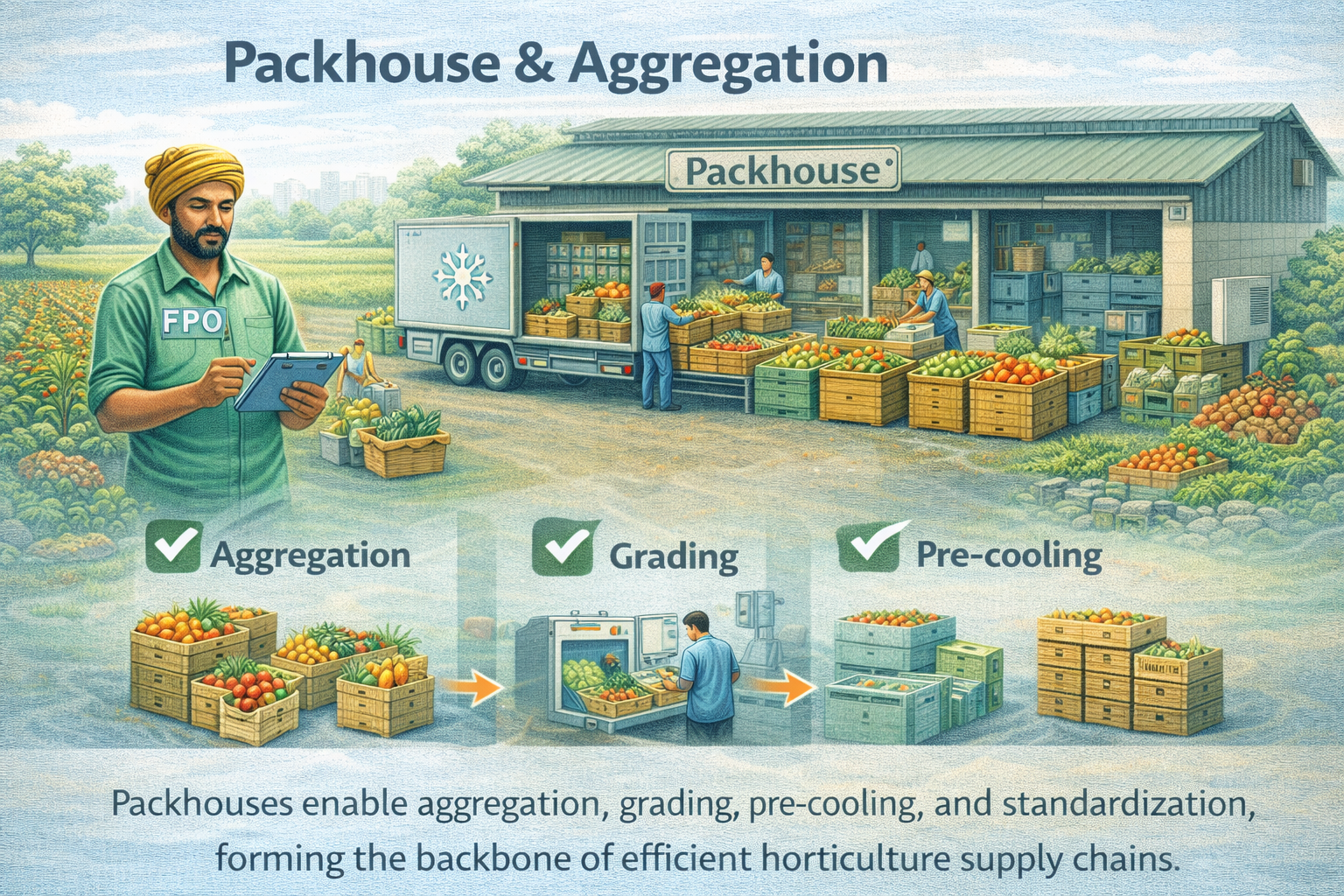
Subsidies without aggregation only increase individual risk exposure.
Technology Alone Will Not Save Farmers
Digital platforms, e-NAM, and traceability tools help only when physical infrastructure exists. Apps cannot compensate for:
- Lack of packhouses
- Poor roads
- Absence of cold transport
Technology must follow infrastructure, not precede it.
The Way Forward: Structural Corrections
What actually works:
- Cluster-based horticulture planning
- End-to-end cold chain design
- Market-linked crop planning
- Private sector logistics participation
- Outcome-based subsidies
- Agricultural supply chain reforms in India
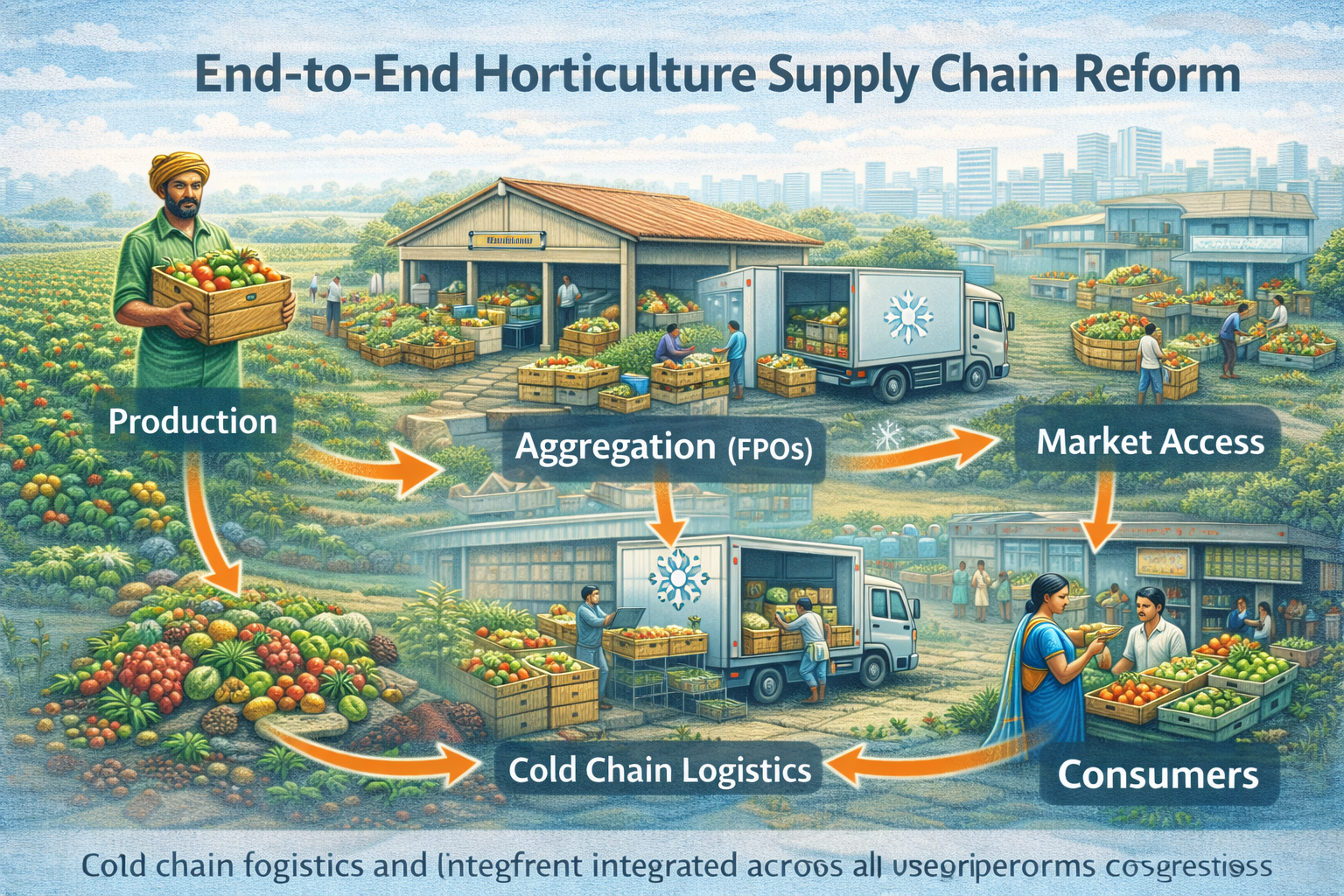
Reforms must shift from intent-driven to system-driven.
Final Thought: Kindness Without Design Is Cruel
Good intentions, unsupported by supply chain design, transfer risk to farmers instead of reducing it. True reform lies not in producing more, but in moving, storing, and selling better.
Frequently Asked Questions (FAQs)
1. What is the horticulture supply chain?
The horticulture supply chain includes all activities involved in moving fruits and vegetables from farms to consumers. This covers harvesting, aggregation, grading, packaging, storage, cold chain logistics, transportation, wholesale markets, processing, and retail distribution. Any weakness in these stages directly affects farmer income and food quality.
2. Why do farmers suffer despite high horticulture production?
Farmers suffer because increased production is not matched with adequate storage, logistics, and market access. When supply exceeds immediate demand and perishables cannot be stored or moved efficiently, prices collapse at the farm gate, transferring financial risk entirely to farmers.
3. What are post-harvest losses in India?
Post-harvest losses refer to the quantity and quality of produce lost between harvest and consumption. In India’s horticulture sector, losses occur due to improper handling, lack of pre-cooling, inadequate cold storage, poor transport conditions, and delayed market access, leading to both physical waste and value loss.
4. Why is cold chain critical for fruits and vegetables?
Fruits and vegetables are highly perishable and sensitive to temperature fluctuations. Cold chains slow respiration, reduce microbial growth, and preserve freshness. Without temperature control from farm to market, even high-quality produce deteriorates rapidly, reducing shelf life, market value, and food safety.
5. How does poor logistics affect farmer income?
Poor logistics increase transit time, spoilage, and market inefficiencies. Farmers are forced to sell quickly at low prices to avoid losses. Delays, damaged produce, and lack of route planning reduce realized prices, even when consumer demand and retail prices remain high.
6. Are subsidies enough to help horticulture farmers?
Subsidies alone are insufficient because they often increase production without addressing market readiness. Without aggregation, storage, logistics, and assured buyers, subsidies can worsen oversupply and price crashes. Structural investments in supply chains create far more sustainable income gains than isolated financial support.
7. What role do FPOs play in supply chains?
Farmer Producer Organisations (FPOs) help small farmers aggregate produce, standardize quality, negotiate better prices, and access institutional buyers. When properly supported with logistics and governance, FPOs reduce individual farmer risk and improve bargaining power across the horticulture value chain.
8. Why does MSP not work well for horticulture crops?
Minimum Support Price (MSP) systems work for storable cereals but fail for perishable horticulture crops. Fruits and vegetables require rapid sale, have volatile demand, and cannot be stockpiled easily. Artificial price floors often distort planting decisions and increase waste instead of stabilizing incomes.
9. What is aggregation in agri supply chains?
Aggregation is the process of pooling produce from multiple farmers into standardized, marketable volumes. It enables efficient logistics, quality control, price negotiation, and access to large buyers. Without aggregation, individual farmers face higher costs, weaker market power, and greater income uncertainty.
10. How does lack of cold transport impact prices?
Without refrigerated transport, produce degrades during transit, forcing distress sales near farms. Buyers discount prices due to quality uncertainty, while distant urban markets face shortages and higher prices. This mismatch results in low farmer earnings despite high consumer prices.
11. What are the biggest gaps in India’s agri logistics?
Major gaps include limited pre-cooling infrastructure, inadequate refrigerated transport, fragmented warehousing, poor rural road connectivity, and lack of integrated planning. These gaps prevent efficient movement of perishables and are a primary cause of post-harvest losses in horticulture.
12. How can private players help horticulture supply chains?
Private players bring capital, logistics expertise, technology, and market access. When properly regulated, they can build efficient cold chains, operate packhouses, optimize distribution, and connect farmers to organized retail and exports, improving efficiency across the entire horticulture supply chain.
13. What is end-to-end cold chain management?
End-to-end cold chain management ensures temperature control from harvest to final sale. It includes pre-cooling at farms, refrigerated storage, temperature-monitored transport, controlled ripening, and cold retail display. Breaks at any stage compromise quality and negate earlier investments.
14. Why do farmers face price crashes during peak harvest?
During peak harvest, large volumes reach markets simultaneously. Without storage or processing capacity, supply overwhelms demand. Farmers must sell immediately to avoid spoilage, leading to sharp price drops, even when long-term demand for the crop remains strong.
15. How does demand forecasting help farmers?
Demand forecasting aligns crop planning with market needs. When farmers know expected demand, they can stagger planting, choose appropriate varieties, and plan harvest timing. This reduces oversupply, stabilizes prices, and improves income predictability in horticulture supply chains.
16. What is the role of packhouses in horticulture?
Packhouses serve as the first structured post-harvest control point. They enable sorting, grading, washing, pre-cooling, and standardized packaging. Packhouses improve quality consistency, reduce damage, and make produce suitable for modern retail, exports, and long-distance transport.
17. Can technology alone solve supply chain issues?
No. Digital platforms, apps, and traceability tools add value only when physical infrastructure exists. Technology cannot replace cold storage, roads, vehicles, or packhouses. In horticulture, infrastructure must come first; technology should enhance, not substitute, physical supply chains.
18. Why do farmers get low prices while consumers pay high?
Multiple intermediaries, inefficiencies, spoilage, and poor logistics inflate costs between farms and consumers. Farmers bear the risk of perishability, while middle layers capture margins. Inefficient supply chains create a paradox where farmers earn less even as retail prices rise.
19. What reforms are needed in horticulture marketing?
Reforms should focus on market-linked production, transparent price discovery, direct buyer access, logistics integration, and reduced intermediation. Strengthening aggregation, cold chains, and contract-based marketing helps align farmer incentives with consumer demand more effectively than price controls.
20. How can supply chain design improve farmer incomes?
Well-designed supply chains reduce waste, stabilize prices, and improve market access. By integrating aggregation, cold storage, efficient transport, and demand-driven planning, farmers can sell better-quality produce over longer periods, reducing distress sales and improving income resilience.


Leave a comment