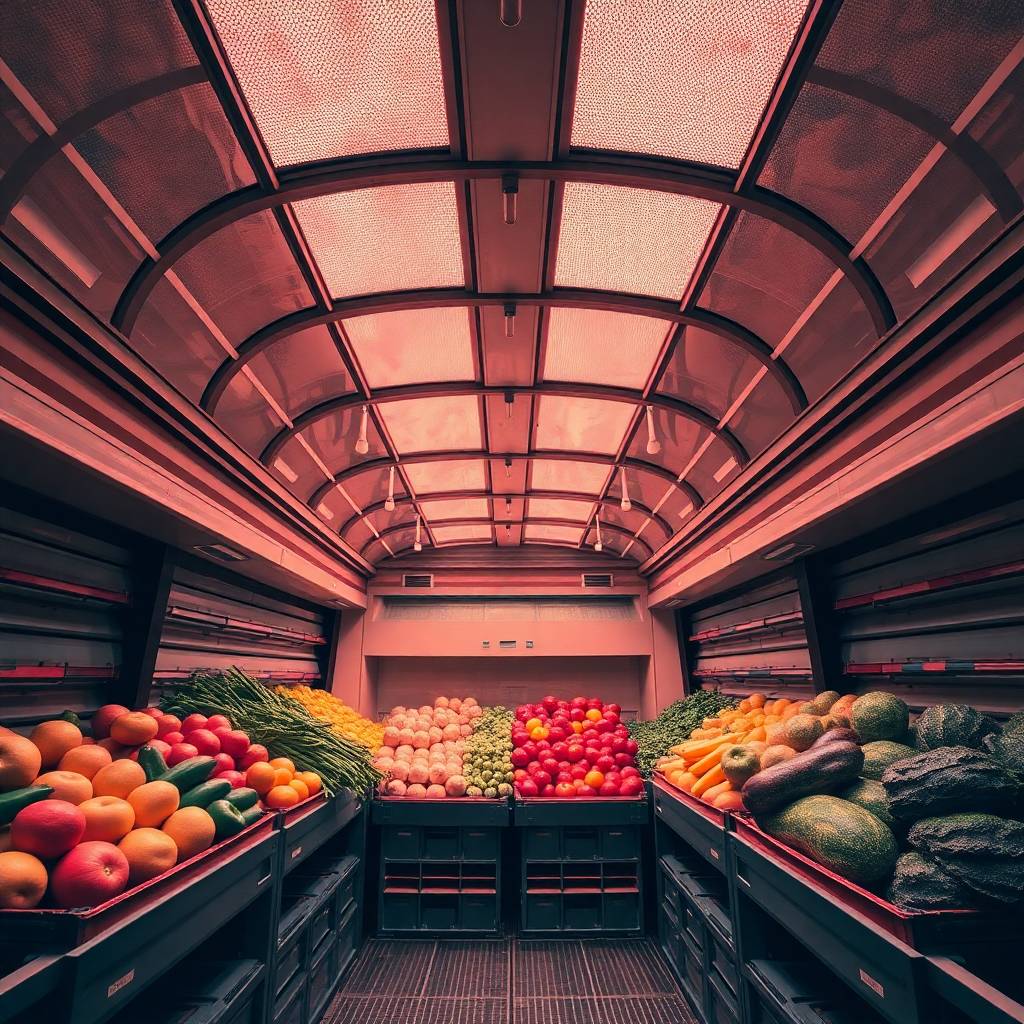
A complete guide to food logistics covering cold chain, warehousing, refrigerated transport, last-mile delivery, technology, and supply chain management from farm to fork.
What is Food Logistics?
Food logistics refers to the integrated planning, execution, and control of the movement and storage of food products from farms and food processing units to wholesalers, retailers, and finally consumers, under controlled conditions that preserve quality, safety, and shelf life.
It includes:
- Post-harvest handling
- Cold chain management
- Warehousing and inventory control
- Temperature-controlled transportation
- Packaging and distribution
- Quality and safety compliance
In modern agri-food systems, food logistics is not just transportation—it is a biological, engineering, and supply-chain management system.
Why Food Logistics is Critical in the Food Supply Chain
According to FAO estimates on global post-harvest food losses, nearly one-third of all food produced for human consumption is lost annually, with the highest losses occurring in perishable fruits, vegetables, meat, and dairy due to inadequate cold chain and logistics infrastructure.
Fruits, vegetables, meat, dairy, seafood, and ready-to-eat foods are highly perishable. Without proper logistics:
- Respiration and enzymatic activity continue
- Microbial growth accelerates
- Moisture loss causes wilting and weight loss
- Temperature abuse leads to rapid spoilage
- Economic losses increase across the value chain
Globally, 25–35% of food is lost post-harvest, and in developing economies this can exceed 40%, mainly due to poor logistics and cold chain gaps.
Stages of Food Logistics (Farm to Fork)
- Harvesting & Collection
- Pre-Cooling & Primary Processing
- Packhouse Operations
- Cold Storage & Controlled Atmosphere Storage
- Refrigerated Transportation (Reefer Logistics)
- Distribution Centers & Dark Stores
- Retail / Quick Commerce Fulfilment
- Last-Mile Delivery to Consumers
The concept of cold chain definition and farm-to-fork temperature control emphasizes uninterrupted refrigeration and humidity management from harvest through processing, storage, transportation, and retail.
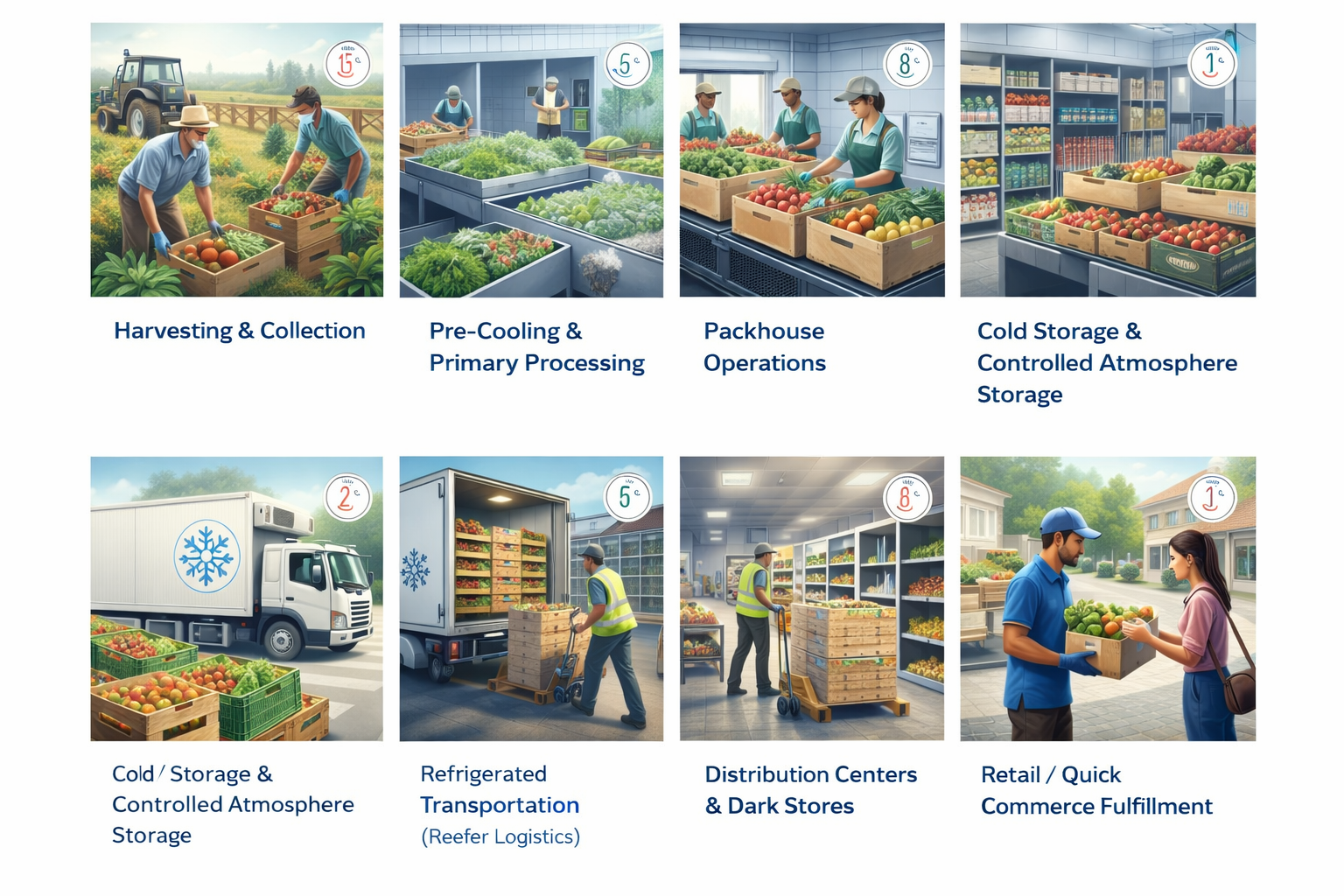
Each stage requires precise control of temperature, relative humidity, atmosphere, and handling practices.
What is Cold Chain Logistics?
Cold chain logistics is the temperature-controlled segment of food logistics that maintains products within their optimal thermal and humidity ranges from harvest to consumption.
Key components:
- Pre-cooling systems
- Cold storage (chillers, freezers, CA rooms)
- Reefer trucks and containers
- Insulated packaging
- Temperature and RH monitoring sensors
- Backup power and energy management
Scientific research on temperature-controlled supply chain systems shows that even short-term thermal abuse accelerates respiration, microbial growth, and enzymatic degradation in perishable foods.
Optimal Temperature and Relative Humidity for Major Foods
| Commodity | Temperature (°C) | Relative Humidity (%) | Storage Life |
|---|---|---|---|
| Apple | 0–1 | 90–95 | 2–6 months |
| Banana | 13–14 | 85–90 | 2–4 weeks |
| Tomato | 12–13 | 85–90 | 2–3 weeks |
| Grape | 0–1 | 90–95 | 1–3 months |
| Leafy Greens | 0–1 | 95–98 | 1–3 weeks |
| Meat (Chilled) | 0–2 | 85–90 | 1–3 weeks |
| Frozen Foods | −18 | 90–95 | 6–12 months |
Role of Warehousing in Food Logistics
Modern food warehouses are biological preservation facilities, not just storage buildings. FAO technical guidelines on controlled atmosphere storage principles confirm that oxygen, carbon dioxide, temperature, and relative humidity control can extend shelf life of fruits and vegetables by several months.
Functions:
- Temperature and humidity control
- Ripening chambers
- Controlled atmosphere storage
- Sorting, grading, and packaging
- Inventory rotation (FIFO / FEFO)
- Quality inspection and traceability
Green Warehousing
Sustainable food logistics now integrates:
- Rooftop solar PV systems
- Energy-efficient refrigeration
- Thermal insulation and PCM panels
- Rainwater harvesting
- EV charging infrastructure
Studies on solar-powered cold storage economics demonstrate that rooftop photovoltaic systems can reduce refrigeration energy costs by 40–70% while improving operational resilience.
A 100,000 sq.ft. solar-roof warehouse can:
- Power cold rooms and sorting lines
- Support EV last-mile fleets
- Reduce carbon footprint
- Lower operating costs significantly
Transportation of Perishable Foods
According to ASHRAE refrigeration standards on refrigerated transport requirements for perishable foods, precise control of air temperature, relative humidity, and air velocity is essential to prevent moisture loss and chilling injury.
Refrigerated Transport (Reefer Logistics)
Includes:
- Reefer trucks
- Reefer containers
- Insulated vans
- Multimodal cold chain (road, rail, sea, air)
Key requirements:
- Stable temperature
- High relative humidity (85–95%)
- Shock and vibration control
- Continuous monitoring and data logging
EV Two-Wheelers in Last-Mile Food Delivery
In quick commerce and hyperlocal logistics:
- EV two-wheelers dominate short routes
- Lower operating cost
- High delivery frequency
- Zero tailpipe emissions
- Integrated with dark stores and micro-fulfilment centers
Post-Harvest Losses and Logistics Gaps
The World Bank cold chain infrastructure gaps in developing countries report identifies lack of pre-cooling, insufficient cold storage capacity, and weak reefer connectivity as primary drivers of 30–40% horticultural losses.
Major causes:
- Lack of pre-cooling
- Poor cold storage distribution
- Inadequate reefer transport
- Road infrastructure bottlenecks
- Power supply instability
- Improper packaging
- Temperature and RH fluctuations
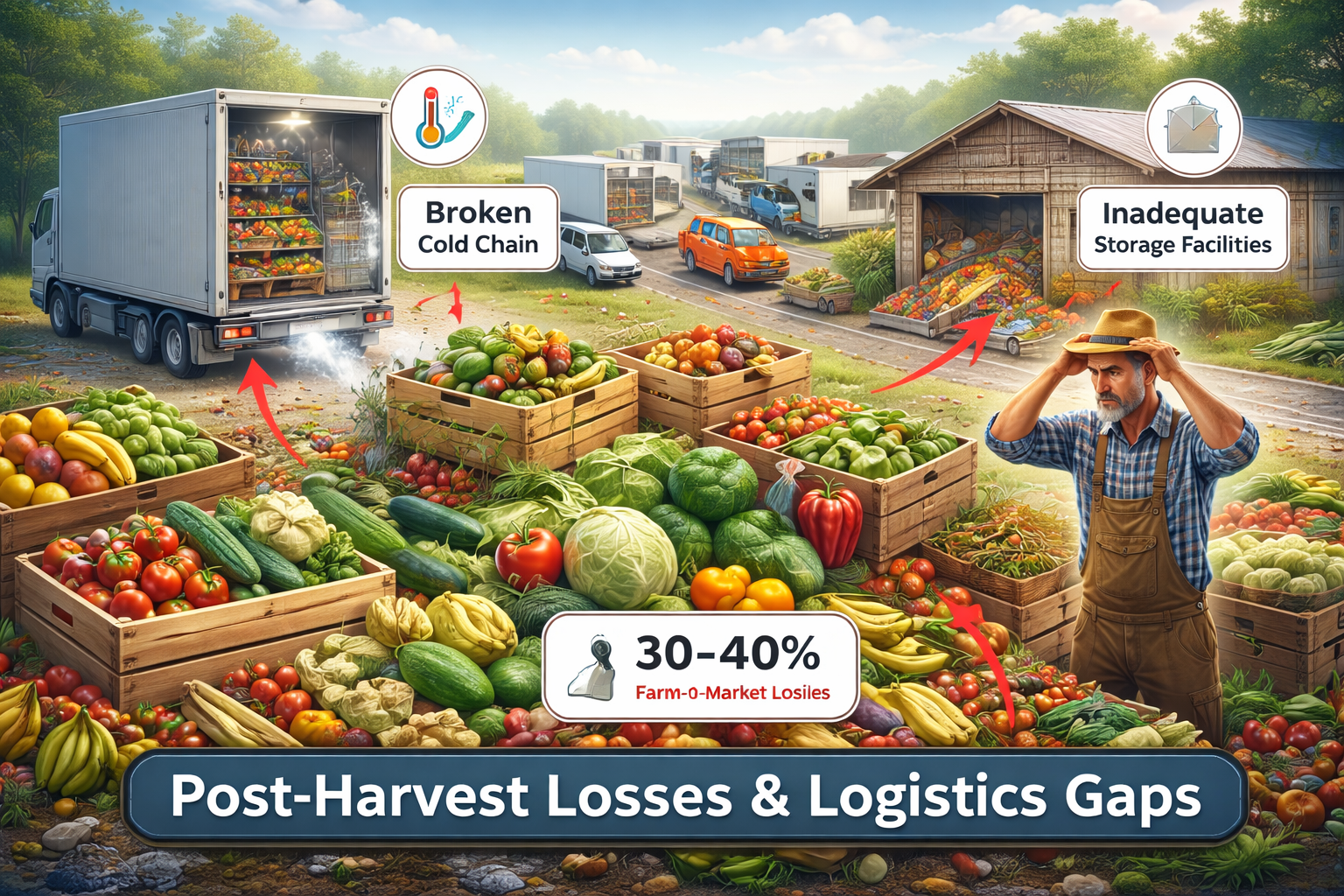
Losses translate into:
- Reduced farmer income
- Higher consumer prices
- Lower export competitiveness
- Food security risks
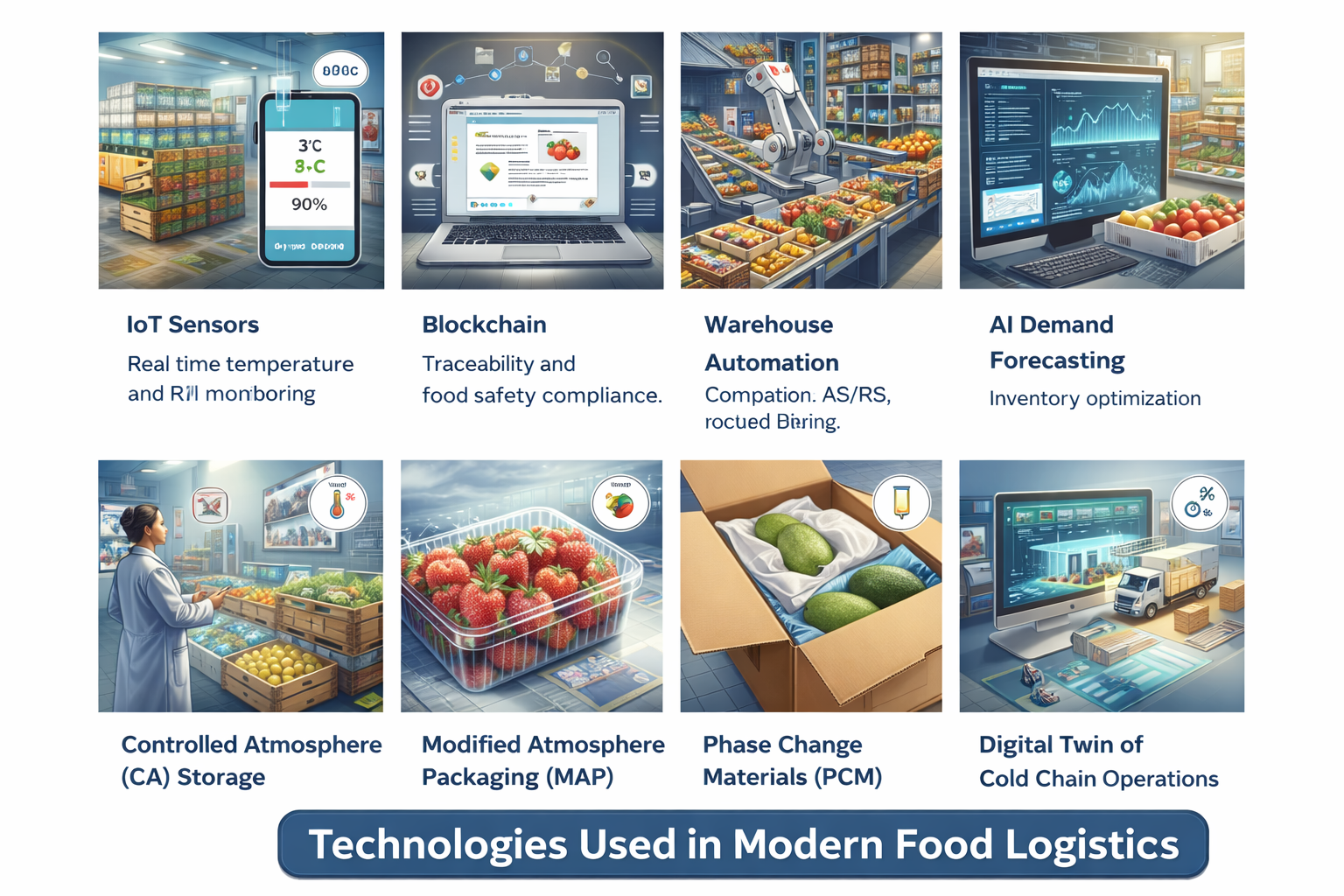
Technologies Used in Modern Food Logistics
Recent studies on IoT-based temperature and humidity monitoring in cold chains show that real-time sensor networks significantly reduce temperature excursions and spoilage risk.
- IoT Sensors – Real-time temperature and RH monitoring
- Blockchain – Traceability and food safety compliance
- Warehouse Automation – Conveyors, AS/RS, robotic picking
- AI Demand Forecasting – Inventory optimization
- Controlled Atmosphere (CA) Storage
- Modified Atmosphere Packaging (MAP)
- Phase Change Materials (PCM) for Thermal Stability
- Digital Twin of Cold Chain Operations
FAO research on blockchain for food traceability and safety compliance highlights its role in improving transparency, recall efficiency, and regulatory compliance across food supply chains.
Food Logistics in India: Challenges
- Fragmented cold chain network
- High cost of reefer transport
- Power and energy inefficiency
- Road infrastructure at micro-level
- Lack of packhouses near farms
- Limited adoption of solar and green warehousing
- Skill gaps in cold chain operations
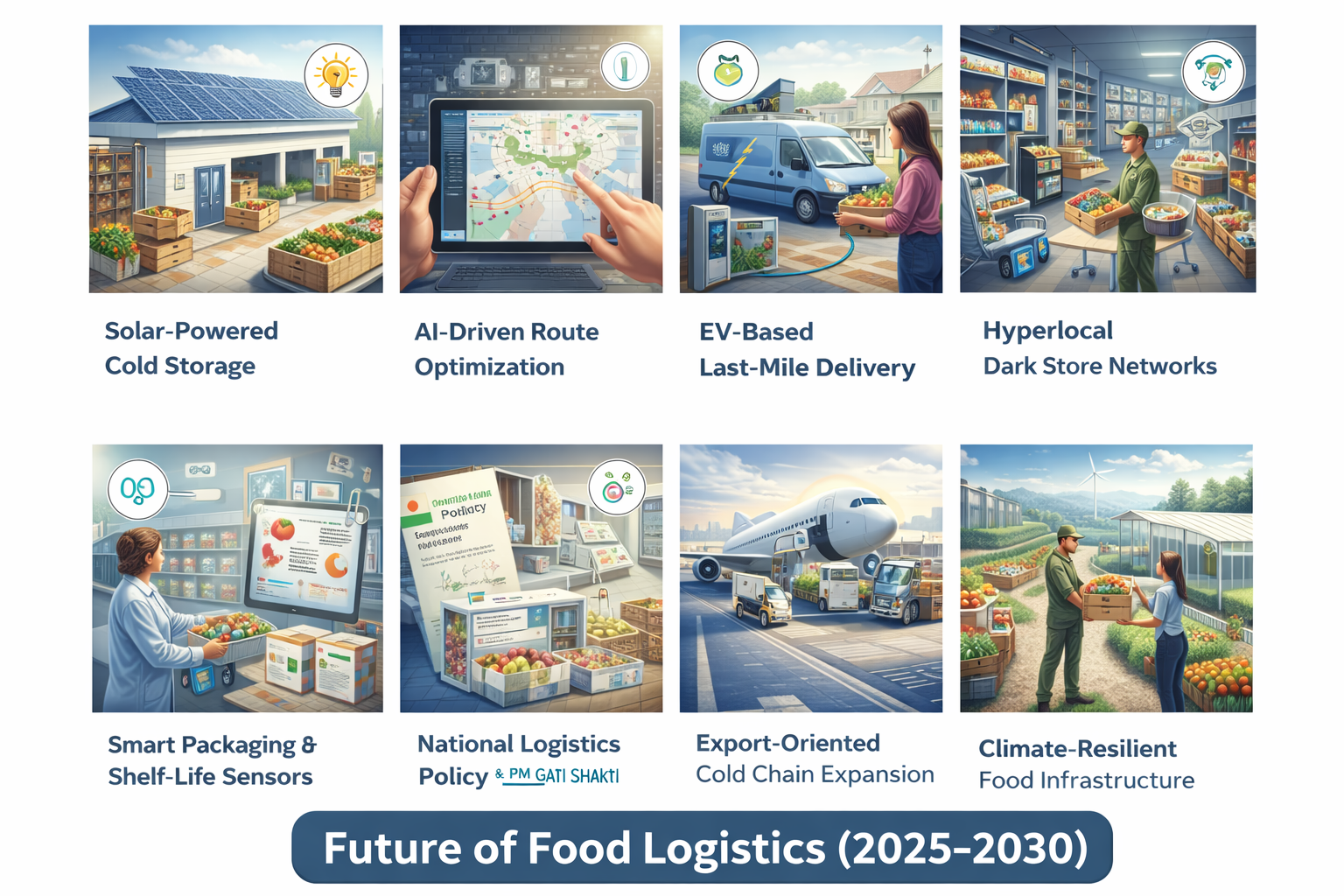
Future of Food Logistics (2025–2030)
The integration of cold chain infrastructure under India’s National Logistics Policy and PM Gati Shakti Master Plan aims to improve multimodal connectivity, reduce logistics cost, and strengthen agri-export competitiveness.
The future will be shaped by:
- Solar-powered cold storage
- AI-driven route optimization
- EV-based last-mile delivery
- Hyperlocal dark store networks
- Smart packaging and shelf-life sensors
- National Logistics Policy & PM Gati Shakti integration
- Export-oriented cold chain expansion
- Climate-resilient food infrastructure
Key Takeaways
- Food logistics is a temperature-, humidity-, and time-critical system.
- Cold chain is the backbone of perishable food supply chains.
- Warehousing, transportation, and energy management are interlinked.
- EVs and solar power are transforming last-mile and storage operations.
- Infrastructure quality determines logistics efficiency and food security.
FAQ:
What is food logistics?
Food logistics is the management of storage and transportation of food under controlled conditions to maintain safety, quality, and shelf life.
What is cold chain logistics?
Cold chain logistics is the temperature-controlled part of food logistics covering pre-cooling, cold storage, and refrigerated transport.
Why is temperature control important in food supply chain?
Temperature directly affects respiration, microbial growth, and enzymatic activity, determining shelf life and safety.
What is the role of warehousing in food logistics?
Warehousing preserves quality, buffers inventory, enables sorting and packaging, and stabilizes supply.
How can post-harvest losses be reduced?
Through pre-cooling, cold storage, refrigerated transport, proper packaging, and continuous temperature-humidity monitoring.
Final Conclusion
Food logistics is the biological life-support system of the global food supply chain. It integrates post-harvest physiology, cold chain engineering, warehousing science, transportation management, energy systems, and digital technology.
In the era of quick commerce, EV mobility, green warehousing, and climate-conscious supply chains, the future of food security will be decided not in fields alone, but in the efficiency of logistics systems that connect farms to forks.
Temperature slows decay.
Humidity preserves freshness.
Infrastructure enables speed.
Energy ensures sustainability.
Together, they define the science and strategy of modern Food Logistics.


Leave a comment